



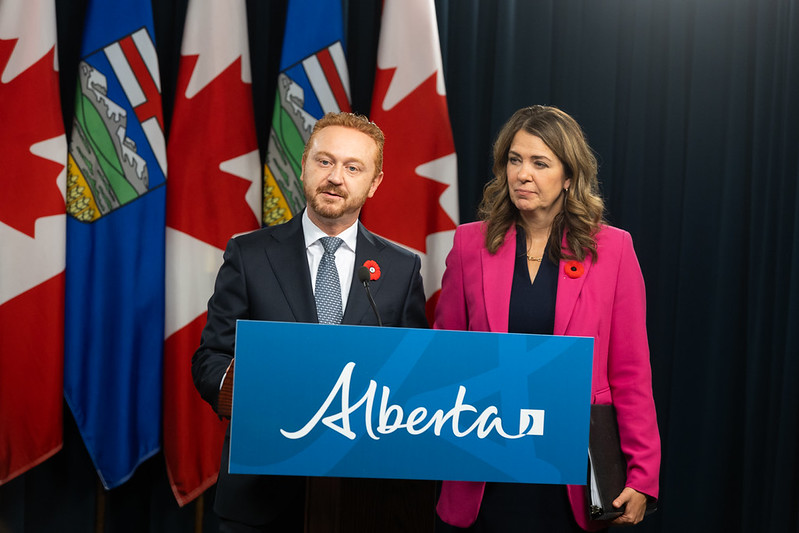
Alberta is preparing to invoke its Sovereignty Act over Ottawa's repeal of a good-faith religious opinion defence for certain hate propaganda offences under the Criminal Code.
Premier Danielle Smith and Justice Minister and Attorney General Mickey Amery announced the proposed motion Tuesday, arguing the changes could discourage lawful religious and political expression.
Related Stories:
-
Alberta proposes home setbacks, farmland limits for large data centres
-
Alberta announces new high school graduation requirements for 2028
Ottawa said in June, when it announced the legislation had received royal assent, that the changes did not criminalize religious teachings, sermons or scripture readings.
“We just don't want to wait until somebody's pastor has been hauled off to jail, or somebody's imam, or somebody's rabbi,” Smith said.
Neither Smith nor Amery identified a specific case during Tuesday's news conference in which an Albertan had faced prosecution for expressing religious beliefs following the repeal. Amery could not provide figures on hate-related cases in Alberta since the law took effect July 18.
If approved by MLAs, the motion under the Alberta Sovereignty within a United Canada Act would urge cabinet to consider further measures to protect lawful political and religious expression, including the reading and quoting of sacred texts. The province also wants to educate Albertans about their rights while continuing to address criminal conduct.
Amery provides no figures for period since July 18
Asked whether the government was aware of arrests or charges resulting from the expression of religious beliefs or opinions, Amery cited 14 cases involving hate-crime offences in Alberta in 2025-26, adding that there were likely more investigations.
When pressed for figures covering the period since the federal law took effect, he responded: “I don't have the specific ones from July until today. No.”
Amery did not specify how many of the 14 cases involved religious expression or hate propaganda offences. He said the government's intention was to act before potential problems arose and prevent Albertans from becoming reluctant to practise their faith or voice political opinions.
The minister raised concerns about people quoting passages from the Bible, Quran or Torah. Asked which specific religious teachings the government believed could now attract prosecution, including whether its concerns extended to school curricula, he referred generally to scripture and sermons without identifying particular teachings or passages.
What Ottawa changed
The federal Combatting Hate Act, formerly Bill C-9, received royal assent June 18, with its provisions coming into force 30 days later.
Before the amendments, the Criminal Code contained a specific defence for certain hate propaganda offences involving the good-faith expression of an opinion on a religious subject or a belief based on a religious text, according to the federal Department of Justice. That defence, which predated the Canadian Charter of Rights and Freedoms, has been repealed.
In a backgrounder last updated Aug. 25, the department said removing the defence did not broaden the offences. Prosecutors must still establish an intention to promote hatred or antisemitism, a requirement Ottawa says is reinforced by new provisions in the law.
“Religious sermons, texts and teachings communicated in good faith, such as preaching, or scriptural readings would not meet this standard,” the department said.
The amendments also define hatred as an emotion of an intense and extreme nature clearly associated with vilification and detestation, drawing on existing Supreme Court of Canada rulings, according to the department.
“The law also specifies what is not hatred – namely, acts that solely humiliate, discredit, hurt or offend,” the backgrounder states.
Ottawa maintains the law does not criminalize opinions, disagreement or criticism, prohibit peaceful protest and political advocacy, or create protest-free zones around protected buildings.
Ottawa's case for tougher hate-crime laws
Police-reported hate crimes in Canada more than doubled between 2018 and 2024, with most targeting race or ethnicity and religion, according to figures published by the federal Department of Justice in June.
Of the police-reported hate crimes targeting religion in 2024, 70 per cent were directed toward Jewish populations and 17 per cent toward Muslim populations. Among hate crimes motivated by race or ethnicity, Black people have been the most frequently targeted population since 2020, accounting for 37 per cent of those crimes in 2024.
“We’ve seen synagogues struck by gunfire, places of worship vandalized or burned, and people being targeted in their own communities. That is unacceptable. We cannot allow that kind of hate to become normal in Canada,” federal Justice Minister and Attorney General Sean Fraser said in a June 19 news release.
Bill C-9 created separate offences for intentionally intimidating people to prevent them from accessing religious or cultural institutions and for deliberately blocking or interfering with lawful access to those places. Each offence carries a maximum penalty of 10 years in prison, according to the federal department.
The protections cover cemeteries and buildings primarily used for religious worship, including churches, synagogues, mosques, temples and gurdwaras, as well as certain schools, community facilities and seniors' residences primarily used by identifiable groups.
The law also created a specific hate-crime offence covering federal offences motivated by hatred on grounds such as race, religion, sex or sexual orientation.
The federal department gives uttering threats as an example: the maximum prison sentence on indictment rises from five to 10 years when prosecuted under the new hate-crime offence.
A fifth hate propaganda offence makes it a crime to wilfully promote hatred against an identifiable group by publicly displaying certain terrorism or hate symbols. These include symbols principally used by or associated with listed terrorist entities, two specified Nazi symbols and a noose.
The department says legitimate educational, artistic and journalistic displays are not captured by the offence.
Police and prosecutors already received guidance
Alberta began responding to the federal amendments months before announcing the Sovereignty Act motion.
In August, Public Safety and Emergency Services Minister Mike Ellis told Alberta law enforcement its priority remained stopping crime rather than policing opinions, according to the province. The following month, Amery issued guidance to Crown prosecutors to give significant weight to freedom of expression and not pursue charges simply because someone expressed controversial, provocative or unpopular political or religious beliefs.
Asked what the motion would accomplish beyond those earlier measures, Amery said it would reinforce them.
“It seeks to compel cabinet to come forward with additional measures as well, and it confirms to Albertans exactly where we stand on this particular issue.”
Amery referred to the continued development of criteria for hate-related prosecutions but did not identify specific measures other government departments would undertake. He said those decisions would be left to the ministers responsible.
Smith was also asked which other ministries could become involved.
“The federal government, yes, has the constitutional authority to define what areas they believe should be in the criminal code. We have the authority to decide which areas of priority we have for policing, and which areas of priority we have for prosecution.”
The premier compared the approach to Alberta's response to federal firearms measures. She described the immediate response as an exercise of provincial policing and prosecution powers, saying she hoped debate in the legislature would send a signal across other ministries.
“Freedom of expression is not a license for violence, for threats, or criminal hatred,” Amery said, adding that attacks, intimidation and violence directed at religious communities or other groups would continue to be investigated and prosecuted.
Amery addresses prosecutorial discretion
The federal amendments retained a requirement for prosecutors to obtain the attorney general's consent before certain hate-related charges can proceed, according to the Alberta government.
Amery was asked whether he would intervene if an individual Crown prosecutor pursued a case he believed was inconsistent with the September guidance.
“No, we will not interfere with individual prosecutorial discretion,” he said.
“The guidance that is issued to prosecutors is guidance that is overall guiding policy. It is not directed at any individual prosecutor.”
Amery added: “But if we find that there is a problem, certainly I will exercise my role as attorney general and deal with it.”
That could mean revisiting or reissuing the guidance, or speaking with Crown prosecution management to ensure it was being followed, he said.
Asked what Alberta wanted Ottawa to change, Amery described retaining the religious opinion defence as the minimum the province had sought.
“And I think that if the federal government had maintained the exception within the criminal code, then we probably wouldn't be here today.”
What can the Sovereignty Act accomplish?
Alberta cannot restore a repealed Criminal Code defence through a provincial legislative resolution.
Under the Sovereignty Act, enacted in 2022, MLAs can approve resolutions responding to federal laws or other initiatives they believe violate the Constitution by intruding on provincial powers or violating Charter rights. They can also respond to initiatives they believe cause or could cause harm to Albertans by interfering with those powers or rights.
A resolution must identify measures cabinet should consider taking and, where applicable, explain the harm or potential harm.
Although Amery spoke of compelling cabinet to act, the law says cabinet may take further measures once MLAs approve a resolution. Passing it does not automatically put those measures into effect.
Under the act's August 2025 consolidation, cabinet can direct ministers to exercise their powers or issue binding directives to provincial entities where necessary or advisable to carry out measures identified in the resolution.
Cabinet can also direct ministers to suspend or change how regulations apply, or introduce provisions to supplement or replace them, if it considers the action to be in the public interest. Those changes require cabinet approval.
Orders issued under those powers take precedence over conflicting regulations to which they relate, but cabinet cannot use the powers to rewrite laws passed by the legislature.
Municipalities, school boards, municipal police services and public post-secondary institutions are among the entities listed in the August 2025 consolidation. The document notes that an amendment to the definition of provincial entities had yet to come into force at the time.
Directives can apply broadly or target particular organizations. Provincial entities and their members, officers and agents must comply, as must the provincial Crown, its ministers and agents. The directives must be published in the Alberta Gazette within 30 days of the cabinet order.
Cabinet generally has two years from the resolution's approval to issue orders. Those orders also expire at that point, or earlier if MLAs cancel the resolution. Cabinet can extend an existing order once for another two years.
The act does not authorize orders contrary to Canada's Constitution or directives forcing people or organizations that are not provincial entities to violate federal law. Alberta's published explanation also says cabinet cannot issue instructions to provincial entities outside the province's jurisdiction.
Nor does the act diminish existing Aboriginal and treaty rights recognized under Section 35 of the Constitution Act, 1982.
The law restricts certain legal proceedings against the provincial Crown, ministers and other officials. It also protects people and organizations from proceedings over actions or omissions made in good faith under directives.
Anyone seeking a court review of a decision or action taken under the Sovereignty Act must file and serve an application within 30 days of that decision or action. The provision does not itself extend that review process to decisions or acts of the legislature.
Alberta says proposed measures undergo legal review and that the government will respect court decisions if its response is successfully challenged.
The province previously announced measures involving the Sovereignty Act in disputes with Ottawa over electricity regulations in November 2023, economic policy in November 2024 and firearms in December 2025.
No changes planned to Alberta's Human Rights Act
Alberta has its own legislation restricting certain public statements and publications. During Tuesday's news conference, Amery was asked whether the province should reconsider Section 3 of the Alberta Human Rights Act while challenging Ottawa's law.
“Look, no changes are being contemplated to the Human Rights Act at this time,” he said.
Section 3 prohibits certain public statements, publications, notices, signs, symbols and other representations that indicate discrimination or an intention to discriminate, or are likely to expose people to hatred or contempt based on protected grounds. Those include race, religious beliefs, gender, gender identity, gender expression, disability and sexual orientation.
However, Section 3(2) states:
“Nothing in this section shall be deemed to interfere with the free expression of opinion on any subject.”
The legislation contains limited exceptions to its publication restrictions. Under Section 11, a person can defend their conduct by showing it was reasonable and justifiable in the circumstances. If they establish that, the law treats the violation as not having occurred.
The provincial law operates separately from federal hate propaganda prosecutions. Complaints are handled through Alberta's human rights system, where tribunals can order remedies, including compensation in certain circumstances.
Amery said the government could revisit the legislation, as it does other provincial laws, to ensure compliance with the Charter.
Among the laws Alberta considered in developing its motion is the Alberta Bill of Rights, which recognizes freedom of religion, speech, expression and the press. It applies to Alberta's legislature and government in matters within the province's law-making powers.
The provincial bill permits reasonable limits prescribed by law that can be demonstrably and proportionately justified, based on evidence, in a free and democratic Alberta. Amendments made in 2024 also allow the legislature to pass laws that expressly override protections under the Alberta Bill of Rights.
The Canadian Charter separately guarantees freedom of conscience and religion, thought, belief, opinion and expression, subject to reasonable limits prescribed by law that can be demonstrably justified in a free and democratic society.
Why now?
The announcement came ahead of the United Conservative Party's annual general meeting, with reporters questioning whether its timing was connected to concerns among party members about Bill C-9.
Amery cited the government's fall legislative workload, the time needed to prepare the motion and unsuccessful efforts to persuade federal counterparts to retain the religious opinion defence.
“It also only came into effect in July. This is our first available opportunity,” Smith said.
The premier said Alberta had hoped Ottawa would change course. Discussing the province's decision to formalize its policing and prosecution priorities, she said: “Part of the reason we can't act, we can't act in our province to stop something until it's become formal law.”
The Sovereignty Act, however, is not restricted to existing federal laws. Its definition of a federal initiative expressly includes “a proposed or anticipated federal law, program, policy, agreement or action.”
The legislation also permits resolutions addressing potential harm from federal initiatives. Smith did not elaborate on whether Alberta could have pursued a resolution before the amendments came into force.
Pressed on whether the announcement was intended to appeal to UCP members ahead of the annual meeting, Smith argued that concerns about religious freedom extended beyond the party's membership.
No court challenge announced
Amery indicated the government expected to introduce the motion Tuesday. It was not listed on that day's order paper, and the afternoon's Hansard did not record its introduction or a vote. Speaking during debate on the Electoral Divisions Act, NDP MLA David Shepherd referred to an anticipated Sovereignty Act debate Thursday, Nov. 26, although the motion was not expressly identified in the published schedule of projected government business for that day.
Alberta did not announce plans Tuesday to challenge Bill C-9 in court. Amery acknowledged that religious organizations, political activists and legal groups across Canada had raised concerns about the legislation but said he was unaware of an existing legal challenge.
“If it does, we'll look at what role Alberta plays in that,” he said, declining to speculate further.
Get the facts
Add DiscoverAirdrie as a Preferred Source on Google to see more of our stories in your search.









 Wed, Nov 25, 10:00 AM


 Full-time, Hourly, Labour, Skilled Trades